

There’s a lot of misinformation out there about what makes a great projected image, so we’ve pulled together what we’ve learned over years of courses, calibration and installation. This is Part 1 of a short series of posts.
When you’re shopping for a home cinema projector, it’s incredibly easy to get blinded by the numbers. Specifically, one number: lumens.
Manufacturers love to plaster massive brightness specs across their boxes. It makes sense on paper—bigger number equals better picture, right? Well, not exactly. TVs went through the same thing: LCDs won the brightness wars on paper, but OLED’s near-perfect blacks won over most who watched the two side by side.
It also helps to know what a lumens figure actually measures. Lumens describe how much light the projector puts out. What your eyes see is the light coming back off the screen, measured in nits, and that depends on your screen size and gain. The same projector can look dazzling on a small screen and dim on a large one.
Brightness matters for fighting ambient light in a living room. But a truly immersive home cinema experience isn’t built on raw light output. If you want that “better than the local cinema” feeling in a dark or dedicated room, three things matter far more: contrast, black level and dynamic range.
We’ll dig into each of those later in the series. First, it helps to understand how your eyes actually work.
1. How Your Eyes Actually See
Our eyes are far more sensitive to contrast, shadow and darkness than they are to bright white.
While it feels like bright lights catch our attention faster, our visual system is wired to detect the absence of light and subtle shifts in dark tones. Here’s why.
1.1 Your Eyes Judge Light Relatively, Not Absolutely
Imagine you’re in a bright white room and someone switches on a small torch. You’d barely notice it. Now imagine a pitch-black room where someone strikes a single match. You’d see it instantly from across the room.
The match is far dimmer than the torch. What changed is the contrast. Our eyes don’t measure light in absolute terms; they measure the difference between one area and its surroundings. Scientists describe this with Weber’s law: the smallest change you can detect is proportional to the background level. Against a dark background, tiny changes stand out. Against a bright one, they disappear.
That’s the key to this whole article. A projector’s job isn’t just to throw out light. It’s to create differences in light, and the deeper the blacks, the more room every highlight and shadow detail has to work with.
1.2 Your Brain Processes Darkness Faster
When light hits your retina, the signal splits into two broad channels: “On” pathways that respond to increases in light and “Off” pathways that respond to decreases. Research from the SUNY College of Optometry (Komban et al., 2014) found that dark stimuli are processed faster than light ones. The same lab has also shown that “Off” signals dominate parts of the visual cortex.
In plain terms, your brain gives darkness priority. It’s quick to spot where shadows fall, where edges are, and when something that should be black isn’t quite black.
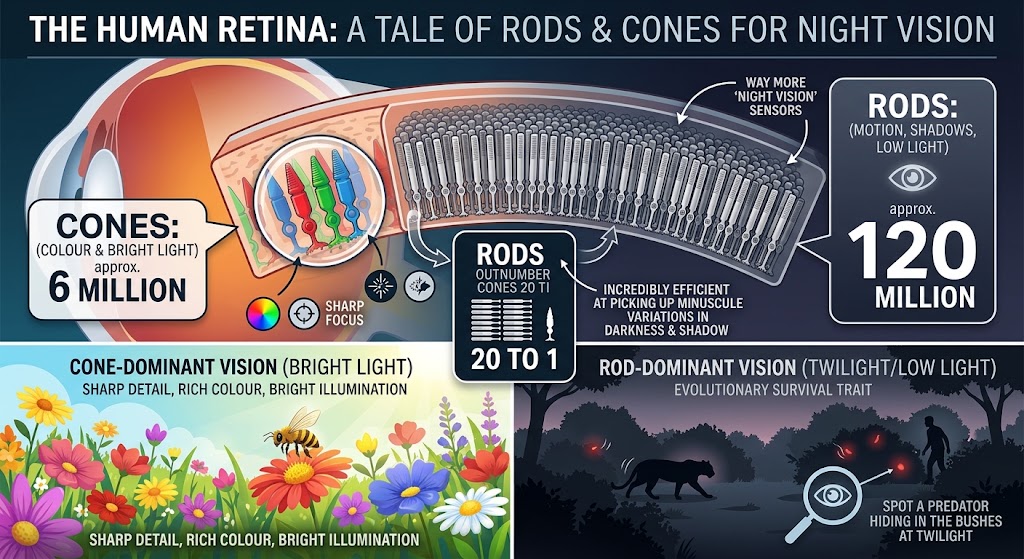
1.3 Rods, Cones and Dark Scenes
Your retina has two types of light sensor. Cones (around 6 million) handle colour and fine detail, and they do most of the work when you watch a normal, well-lit scene. Rods (around 120 million) are colour-blind but extremely sensitive to light, and they’re concentrated in your peripheral vision rather than the centre.
When a film moves into a really dark scene, such as a night sky, a dimly lit room or a slow fade to black, your eyes move into what scientists call mesopic vision, where rods and cones work together. Dark scenes on a projector sit right in this range.
That’s why a poor black level is so noticeable. Your most light-sensitive sensors are watching the edges of the picture: the letterbox bars, the corners of a star field, the dark walls of the room. If “black” is really a dim grey glow, your peripheral vision picks it up even while you’re focused on the centre of the screen.
It also explains why an overly bright image can work against you. Rods take around 20–30 minutes to fully adapt to the dark, and a sudden flash of bright white sets them back. Your eyes then need time to recover before they can make the most of the next dark scene.
1.4 When Bright Becomes Too Bright
If some brightness is good, is more always better? Not in a dedicated theatre. In a dark room, running a projector too hot stops feeling cinematic and starts to feel uncomfortable.
The Sweet Spot (75–120 nits): This is the range we recommend for a dedicated theatre. For context, a standard commercial cinema is calibrated to just 48 nits, while a premium Dolby Cinema auditorium peaks at around 108 nits.
The Eye Strain Zone (150+ nits): In our experience, this is where things start to go wrong. If a film cuts to a full-frame snowy landscape or a white title card at 150 nits or more, your pupils contract sharply. Over a two-hour film, repeated jolts like that can lead to visual fatigue and even headaches.
What This Means When You’re Buying
Brightness gets a projector noticed on the spec sheet, but your eyes are judging the blacks. In a dark, dedicated room, a projector with deep blacks and strong contrast will look more cinematic than a brighter one that turns black into grey.
So don’t shop on lumens alone. In Part 2, we’ll look at contrast, black level and dynamic range, and what the numbers on the box really tell you about each.